 PROXIMITY.AI
Proactively Solving the Vehicle-Pedestrian Safety Crisis Through Intelligent Technology
Timothy Glynn, Co-Founder & Technical Lead | Ron Smith, Co-Founder & Patent Holder
Pre-Seed Deck
Table of Contents
Click any section to jump directly to that slide.
Pre-Seed Deck
 Proximity.AI
Leveraging AI and mobile technology to proactively solve the vehicle-pedestrian safety crisis.
Timothy Glynn, Co-Founder & Technical Lead
Ron Smith, Co-Founder & Patent Holder
United States
The first proactive mobile safety layer for people on foot, not just people in cars.
IP position: issued patent US 11,993,204 with continuation strategy in progress.
Urgent
Pedestrian fatalities are rising in the highest-risk contexts.
Practical
Phone-native approach avoids expensive hardware rollouts.
Defensible
Patent + two-sided architecture + data-driven deployment.
Pre-seed reality
- Pre-revenue stage.
- App-only third-party estimate: $300,000.
- Core mobile product loop implemented.
Pre-Seed Deck
The Problem
Pedestrian fatalities are rising, and current systems still prioritize vehicle occupants over vulnerable road users.
Rising fatalities
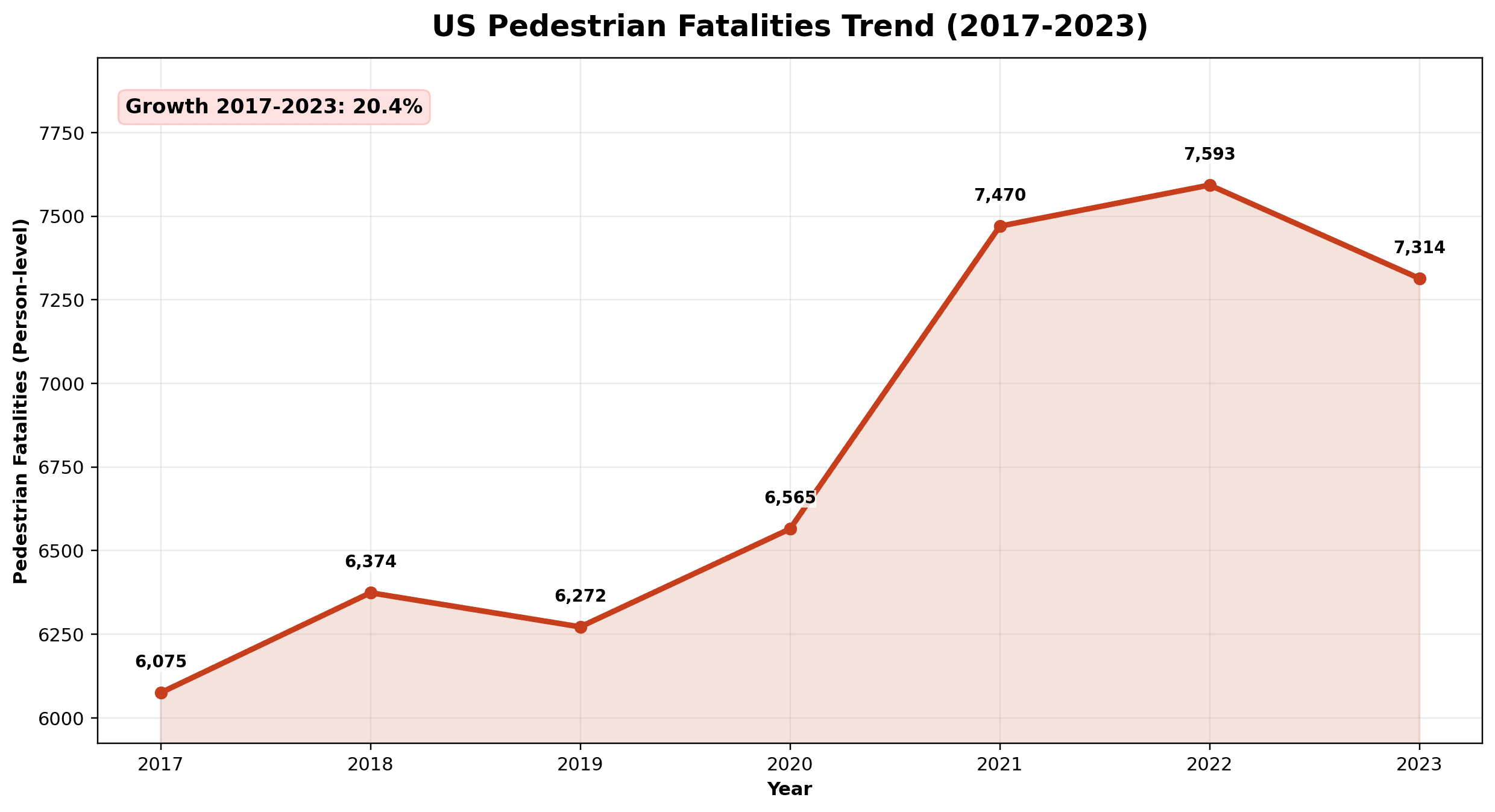
US pedestrian fatalities grew 20.4% from 2017 to 2023.
Scale
47,663 pedestrian fatalities over FARS raw files in this repo (2017-2023).
US Pedestrian Fatalities Trend (Latest FARS Range)
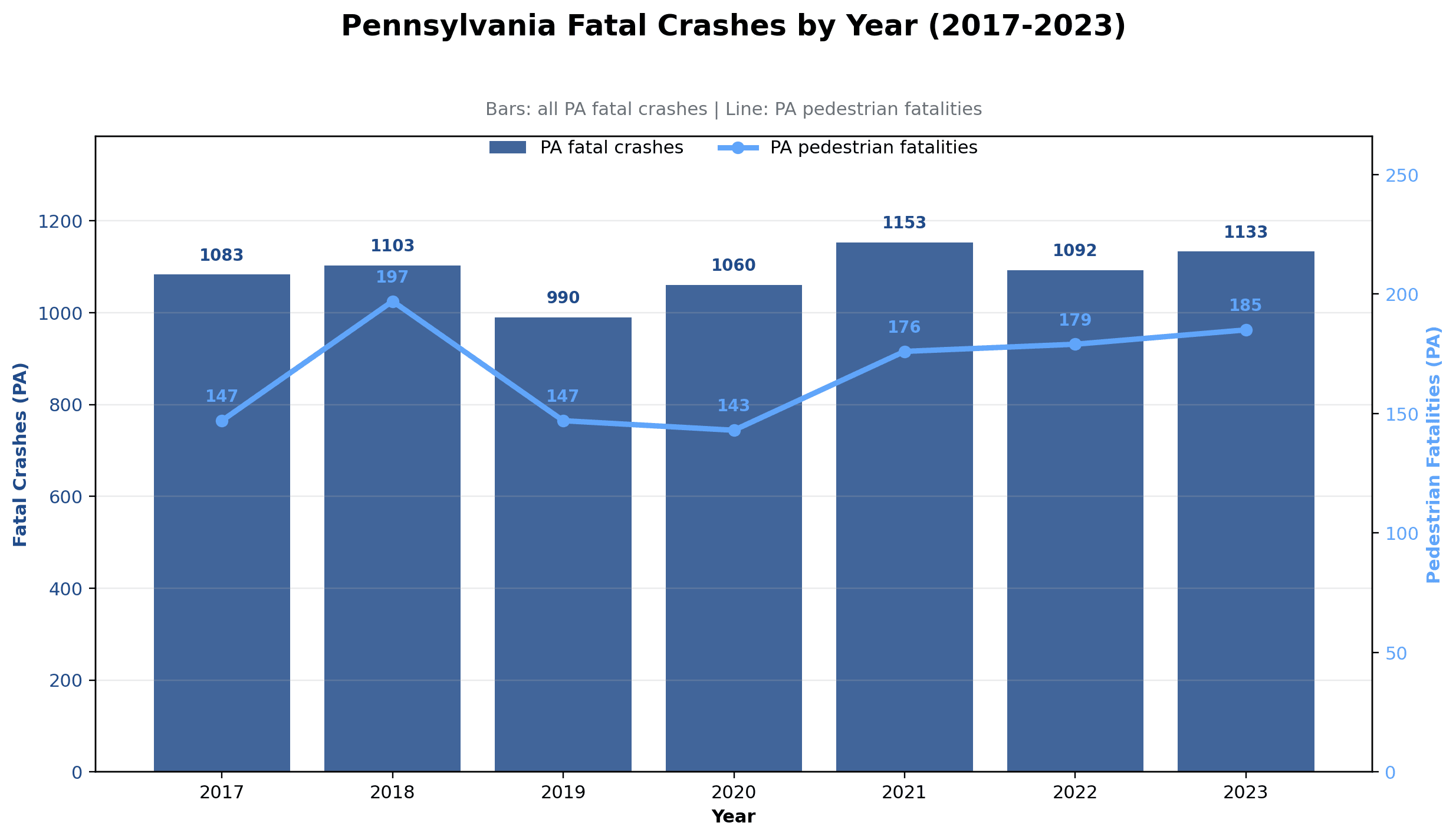
Pennsylvania Fatal Crashes by Year (Latest FARS Range)
Pre-Seed Deck
Why Existing Solutions Fail
The gap is structural: most alternatives are hardware-heavy, one-sided, or too late in the decision cycle.
Vehicle-only ADAS
Protects drivers first. Pedestrians usually get no direct warning channel.
Smart city infrastructure
Expensive, slow procurement cycles, and limited coverage area.
Dashcams/passive alerts
Records incidents but often does not prevent them in real time.
Wearables/hardware
Requires new devices and behavior change before adoption starts.
Failure Pattern Matrix
Interpretation: low two-sided coverage + delayed intervention is the recurring failure mode.
Hardware burden
New physical devices slow onboarding and suppress retention.
One-sided protection
Most tools protect driver OR pedestrian, rarely both at once.
Timing problem
Reactive signals often arrive after conflict has already formed.
Why this gap matters now
- 20.4% growth in US pedestrian fatalities (2017-2023).
- 84.0% of 2023 fatalities in urban environments.
- 36.3% of 2023 fatalities at night.
Pre-Seed Deck
The Solution — Proximity.AI
Proximity.AI uses a proprietary on-device AI model to fuse audio detection and Bluetooth proximity sensing, warning pedestrians and drivers before collisions occur.
Proprietary AI Engine
Proximity Risk Engine
A proprietary model fuses live acoustic patterns and BLE context into one risk score.
Pedestrian Mode
Scans local risk signals and escalates to warning states.
Vehicle Mode
Broadcasts local presence to nearby Proximity users.
Dual-Signal Intelligence
Audio + BLE fusion lowers false negatives versus single-sensor approaches.
Why it matters
- Works on devices people already own.
- No dedicated new hardware required.
- Protects both sides: pedestrian and driver.
- Predictive warning intent, not post-event reaction.
Pre-Seed Deck
How It Works
Detect -> Predict -> Alert. Proprietary model logic that is technically plausible and operationally straightforward.
Live Safety Pipeline
Detect
AI listens for vehicle signatures while BLE checks nearby active devices.
Predict
Proximity, speed context, and direction are modeled in real time.
Alert
Visual, haptic, or audio warning triggers before immediate danger.
Signal Layer
Built on microphones and BLE radios already available in smartphones.
No hardware dependency
Decision Layer
On-device decision loop prioritizes latency, privacy, and local responsiveness.
Fast + privacy-safe
Safety Layer
Objective is early intervention before conflict escalates into collision severity.
Pre-impact intervention
Pre-Seed Deck
AI Model Performance (Current/Unfunded)
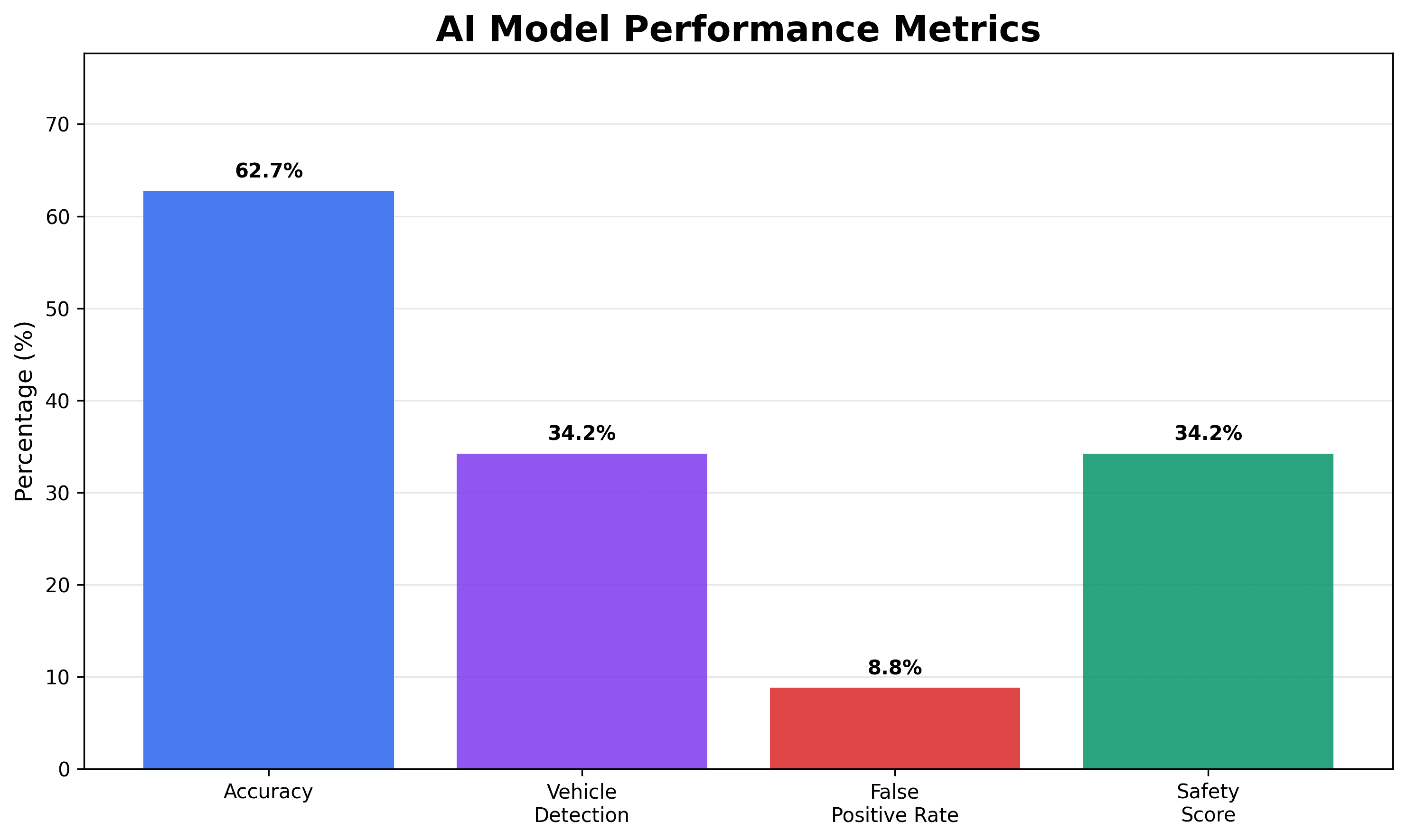
Current model metrics demonstrate technical progress before institutional capital.
AI Model Performance Metrics
What this means today
- Accuracy (62.7%): strong baseline for an unfunded v1 safety model.
- Vehicle Detection (34.2%): meaningful early-warning coverage with room to expand.
- False Positive Rate (8.8%): low enough to protect user trust and limit alert fatigue.
- Safety Score (34.2%): current pre-impact intervention floor before scaling data and tuning.
How funding improves this
- Expand and rebalance training data for higher recall in noisy real-world environments.
- Tune threshold policy by context to increase detection while controlling false positives.
- Run pilot-driven retraining loops to improve edge-case performance and calibration speed.
- Harden on-device inference pipeline for more consistent production behavior across devices.
Important context
This model was trained on an approximately 6GB publicly available urban sound dataset sourced online. It provides a strong unfunded baseline, and pre-seed capital will be used to acquire and label larger, more representative real-world audio data to improve recall, calibration, and edge-case performance.
Pre-Seed Deck
Why Now
Multiple trends are converging: rising fatalities, quieter vehicles, and mature on-device AI capabilities.
Fatalities rising
Pedestrian harm trend is worsening, not stabilizing.
EV adoption
Quieter vehicles reduce natural auditory cues for pedestrians.
Phone capability
Smartphone sensors/compute now support real-time safety workflows.
On-device ML
Local inference improves privacy and response speed.
City pressure
Municipalities need lower-cost, faster safety interventions.
Key takeaway: 36.3% of 2023 pedestrian fatalities happened at night, reinforcing the need for proactive real-time warning.
Evidence & Sources
Fatalities trend and concentration
2017-2023 trend and 2023 urban/night concentrations are computed from NHTSA FARS raw files.
NHTSA FARS data sourceQuieter vehicles are a recognized safety issue
NHTSA established minimum sound requirements for EV/hybrid vehicles to improve pedestrian detectability at low speeds.
USDOT/NHTSA quiet car standardEV adoption is scaling
IEA reports continued EV sales growth, including US growth, increasing the relevance of pedestrian signal gaps.
IEA Global EV Outlook 2025Smartphone + on-device ML readiness
High smartphone penetration plus mature on-device ML frameworks supports privacy-safe, low-latency deployment.
City demand signal: USDOT SS4A fact sheet (federal funding for local road safety planning and implementation).
Pre-Seed Deck
Market Opportunity
Large, exposed user segments exist now, and public/enterprise demand is already funded.
Urban exposure
80.0%
of the U.S. population lives in urban areas, where conflict density is highest.
U.S. Census urban areas factsPedestrian scale
7,314
pedestrians were killed in U.S. traffic crashes in 2023.
NHTSA pedestrian safety (2023)Cyclist adjacency
1,166
pedalcyclists were killed in 2023, with 49,989 injured.
NHTSA Traffic Safety Facts 2023: BicyclistsFamilies & children
73.1M
U.S. residents under age 18 (2024), supporting family safety plans as a real segment.
U.S. Census 2024 age estimatesGig/delivery workforce
1.05M
employees in U.S. couriers and messengers (Jan 2026, seasonally adjusted).
BLS NAICS 492 employmentPre-seed takeaway: the near-term strategic pilot partner profile is urban pedestrians + cyclists + mobility workers, with funded municipal pilot pathways already active.
Pilot notion: university-city corridors (Temple/University City profile) are high-density, recurring pedestrian flows with active safety initiatives already underway. Temple News campus traffic safety article
Pre-Seed Deck
Business Model (Early-Stage)
Multiple monetization paths, with flexibility retained until pilot evidence determines the best primary engine.
Freemium consumer
Adoption engine and top-of-funnel safety utility.
Premium/family plans
Higher-value controls, shared safety coverage, and retention lift.
B2B pilot contracts
Campus, school, and employer programs with measurable outcomes.
Public-sector pilots
City safety initiatives where low-cost deployment is critical.
Insurance pathway
Long-term outcomes-linked partnerships as proof matures.
Commercialization Sequence
Phase A
User adoption + signal quality
Grow active usage and improve alert precision from real-world interaction data.
Phase B
Pilot outcomes + contracts
Convert measured behavior/safety deltas into paid pilot and renewal conversations.
Phase C
Recurring payer expansion
Scale through repeatable institutional channels and long-term partnership models.
Near-Term Revenue Readiness Signals
- Weekly active users and session consistency in high-risk corridors.
- Alert quality metrics: precision, false-positive rate, and user trust retention.
- Pilot proof package: before/after risk-signal and behavior instrumentation.
- Decision-maker validation from campus, city, and employer stakeholders.
Model-to-Monetization Loop
More users > richer safety data > better model performance > stronger pilot outcomes > clearer budget justification for payers.
This keeps monetization tied to demonstrated risk reduction, not speculative pricing assumptions.
Pre-Seed Deck
Traction & Validation
At pre-seed, emphasis is on proof velocity and technical progress, not revenue optics.
Model baseline
62.7% overall accuracy from current unfunded model iteration.
Detection baseline
34.2% vehicle detection rate establishes practical early-warning floor.
Signal quality
8.8% false-positive rate supports user trust and alert usability.
Build Velocity (to date)
IP
Issued patent secured
Product
Dual-mode MVP shipped
Data
FARS pipeline + chart generation
Demo
Interactive in-deck simulation
Risks Reduced So Far
- Technical feasibility: working model and app loop demonstrated.
- Data credibility: claims tied to raw FARS processing and generated outputs.
- Defensibility: issued patent with continuation path in progress.
- Pilot readiness: strategic partner profile and deployment context identified.
What This Round De-risks Next
- Active feedback loop deployment (on-device capture + centralized sync).
- Pilot outcome evidence (behavior and safety-signal deltas).
- Repeatable go-to-market motion with campus/city strategic pilot partners.
Pre-seed interpretation: traction here is measurable progress and validation velocity, not top-line revenue yet.
Sources: US 11,993,204 B2 | NHTSA FARS
Pre-Seed Deck
Competitive Advantage
Why Proximity can be hard to replicate if execution stays focused.
Proprietary risk model
Model architecture is purpose-built for pedestrian safety, not adapted from generic mobility tooling.
Dual-signal model
Audio + BLE fusion reduces single-sensor failure modes.
Pedestrian-first design
Built around vulnerable-road-user outcomes first.
On-device AI
Low-latency inference with privacy-safe architecture.
Cross-role protection
One system serves both walker and driver contexts.
Learning advantage
More real-world safety interactions improve model calibration and edge-case handling over time.
IP alignment
Patent-backed architecture with continuation path reinforces technical defensibility.
Issued Patent
US 11,993,204 B2
Current claims protect core system architecture for proximity-based pedestrian/vehicle safety signaling and alert logic.
View patent recordHow Funding Expands IP Position
- File continuation applications that broaden claim scope across multi-signal detection and warning workflows.
- Protect model-improvement methods from pilot data feedback loops and adaptive thresholding logic.
- Extend claims around deployment contexts: campus corridors, urban intersections, and fleet/enterprise safety programs.
- Build a defensible prosecution roadmap that supports licensing, partnership, and acquisition outcomes.
Pre-Seed Deck
Go-To-Market Strategy
Focused start in university-city safety corridors, then compounding data and distribution loop.
Early acquisition focus
- Urban early adopters
- Campus corridor pilots (university + city streets)
- Parents and schools
- Local Vision Zero-aligned pilot programs
Growth loop
More users > richer signal data > better detection quality > better safety outcomes > stronger word-of-mouth and partner interest.
Strategic Pilot Partner
Temple / University City Pattern
- High daily pedestrian volumes around class-change windows.
- Concentrated geographies simplify instrumentation and pilot operations.
- Campus + city stakeholders already have active traffic-safety agendas.
Proof Signal
- Temple reporting cites 30%+ of undergrads walking/biking to campus daily.
- University City area streets are highlighted in high-injury safety context.
- Speed-camera and bike-lane initiatives indicate near-term pilot readiness.
Acquire
High-risk urban cohorts
Measure
Near-miss and behavior deltas
Improve
Model precision and alert quality
Expand
Pilots to repeatable channels
Pre-Seed Deck
Team
Pre-seed investors are betting on founder quality and execution discipline.
Founding Team
Co-Founder & Technical Lead
Timothy Glynn
Leads product and technical execution across AI modeling, mobile architecture, data systems, and deployment workflows.
Experience across DoD, healthcare, and startup delivery environments.
Co-Founder & Patent Holder
Ron Smith
Originated the core safety concept and opened the underlying patent position that anchors the company's IP foundation.
Brings long-term operational field perspective from healthcare and public infrastructure environments in Philadelphia.
Investable now
Demonstrated ability to convert complex safety and AI concepts into a working product, a defensible IP position, and a pilot-ready go-to-market plan.
What gets added next
Select advisors/operators in AI safety, campus-city partnerships, and insurance/commercial strategy to accelerate scale.
Pre-Seed Deck
The Ask
Direct raise request with transparent fund allocation across product, launch, legal, and company buildout.
Raising
$80,000
Offering: 19.5% of the application
Target runway: 12 months
Current Status: Beta on TestFlight. This raise funds launch readiness and full App Store deployment.
Use of funds
Top technical priority
Active feedback loop: on-device safety events + centralized sync + continuous retraining.
Model + loop (25%)
Retraining and threshold calibration from live field data.
Data acquisition (10%)
New labeled audio/proximity datasets for model + research.
App Store launch (20%)
TestFlight to production release, QA, instrumentation.
Pilot onboarding (15%)
Partner setup, operations, and measured safety deltas.
Marketing/social (10%)
Brand foundation, content, community, early growth.
Legal + LLC/IP (10%)
LLC setup and patent continuation legal execution.
Strategy partner (10%)
Business strategy support, open to investor guidance.
Current baseline and valuation context
- Pre-revenue
- Gust PMV bucket: below $330k (pre-seed/earlier)
- Evidence-first pre-seed approach
- Execution focus: product readiness, legal readiness, and pilot proof
The first proactive safety layer for pedestrians, not just vehicles.
Milestone 1
App Store launch completed from current TestFlight beta.
Milestone 2
Pilot live with active feedback-loop data feeding model improvement.
Milestone 3
Continuation patent + LLC/legal foundation completed.
Get The App & Connect
Thank you for your time and consideration. Launch and execution are ready with the right pre-seed partner.